
Introduction: The Promise That Feels Too Good
When you first look at a budget smartwatch, one claim almost always stands out — battery life.
“7 days battery.”
“Long-lasting performance.”
“Power that keeps up with your lifestyle.”
At first glance, it feels reassuring. Almost comforting. You start imagining a device that quietly stays with you for days without needing attention.
But after actually using a budget smartwatch in real life, I realized something unsettling — these promises are not exactly false, but they are far from the full truth.
And that gap between expectation and reality is where most users feel disappointed.
Battery life is one of the most confusing parts of buying a budget smartwatch.
On paper, brands promise 5 days, 7 days, or even 10 days of battery life.
But in real usage, the experience is often very different.
And this gap between marketing and reality is what most buyers don’t understand before purchasing.
The Illusion of Numbers: Why Battery Claims Feel Misleading
Let’s be honest for a moment.
Brands don’t lie directly. They simply present their best-case scenario.
The “7 days battery” usually comes from:
- Lowest brightness
- Minimal notifications
- No calling
- Limited interaction
In other words, a version of usage that most real users never follow.
This creates a subtle illusion.
You don’t realize it while buying. But once you start using the watch normally, the difference becomes impossible to ignore.
And that moment — when expectations quietly collapse — feels frustrating.

My Personal Realization: When Reality Slowly Sets In
Budget smartwatches often focus on offering more features at a lower price.
But to achieve that, some compromises are made.
Battery performance, sensor accuracy, and optimization are not always consistent across devices.
So while they look powerful, the experience can vary depending on how you use them. 3
During my first week of using a budget smartwatch, I was genuinely impressed.
Everything felt smooth:
- Notifications were instant
- The display looked bright
- Features felt exciting
But then something changed.
By the third or fourth day, I noticed the battery dropping faster than expected. Not dramatically, but noticeably.
At first, I ignored it.
But within a week, the pattern became clear.
👉 What was promised as “long battery life” had turned into a regular charging routine.
That realization was not shocking — it was quietly disappointing.
The Silent Battery Killers You Don’t Notice
Why Budget Smartwatch Battery Drains Faster
There are a few hidden reasons:
- AMOLED display consumes more power
- Always-on display reduces battery by up to 40–50%
- GPS tracking drains battery quickly
- Continuous heart rate monitoring uses extra power
These features look attractive, but they silently reduce battery life in daily use. 2
What makes this situation more complex is that battery drain doesn’t come from one single feature.
It’s a combination of small things — things you don’t even think about.
1. Brightness That Feels Necessary
You increase brightness for better visibility outdoors. It feels normal, but it silently consumes power.
2. Bluetooth Calling (Convenient but Costly)
Calling feels like a premium feature, but it drains battery faster than you expect.
3. Constant Notifications
Every vibration, every screen wake-up — it slowly adds up.
4. Background Health Tracking
Heart rate, sleep tracking — these run quietly, but continuously.
Individually, they don’t seem significant. Together, they reshape the entire battery experience.
Emotional Shift: From Excitement to Adjustment
The Reality Nobody Tells You
Most people don’t use all smartwatch features every day.
But the battery still drains as if you are using everything.
Even background features like notifications, sensors, and syncing keep running continuously.
That’s why even a “7-day battery” smartwatch may last only 3–4 days in real usage.
This is something most technical reviews never talk about.
Battery life is not just about numbers — it affects how you feel about the device.
At first: 👉 You feel excited and impressed
Then: 👉 You feel slightly confused
And finally: 👉 You adjust your expectations
This emotional transition is subtle, but real.
You stop expecting “long battery life” and start managing it instead.
The Psychology of Charging: A Small but Powerful Change
How to Improve Battery Life
If you want your smartwatch to last longer, you can:
- Turn off always-on display
- Reduce screen brightness
- Limit unnecessary notifications
- Avoid continuous GPS usage
- Disable features you don’t use daily
Small changes can significantly improve battery performance.
One of the most unexpected realizations was not about battery itself, but about the habit it creates.
With older devices like fitness bands, charging felt occasional — almost forgettable.
But with a smartwatch, charging becomes a routine.
Not difficult, not annoying — just… present.
And that changes your relationship with the device.
It no longer feels completely effortless. It becomes something you have to maintain.
The Truth Brands Don’t Emphasize
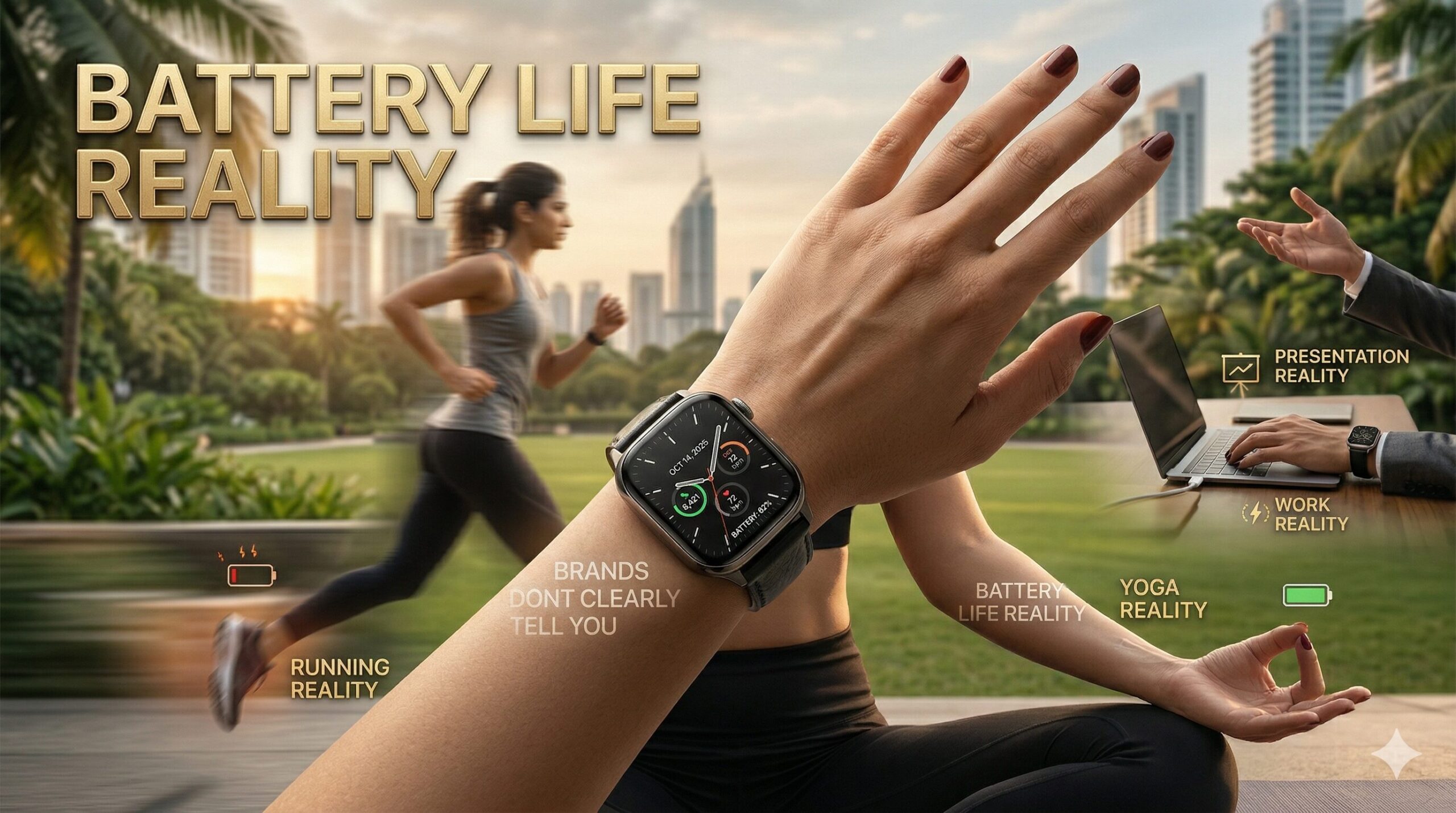
What Brands Don’t Clearly Tell You
Most smartwatch battery claims are tested under ideal conditions.
That means:
- Low brightness
- Limited notifications
- No heavy usage like GPS or calling
In real life, your usage is completely different.
Because of this, many smartwatches deliver only around 60–80% of their advertised battery life. 0
Here’s the honest truth:
👉 Budget smartwatches are not built for extreme battery performance
👉 They are built for balanced experience at a low price
This means:
- More features = more battery usage
- Better display = more power consumption
And once you understand this, everything makes sense.
The problem was never the device.
The problem was the expectation created around it.
What You Should Actually Expect (Realistic View)
Real Battery Life Expectations
Let’s be honest about what you can actually expect:
- Heavy usage (calls, GPS, brightness): 2–5 days
- Normal usage (notifications + tracking): 5–10 days
- Light usage (basic features only): up to 10–14 days
Full-feature smartwatches usually last around 1–2 days, while fitness-focused watches can last much longer. 1
Instead of focusing on advertised numbers, it’s better to think practically.
From real usage:
- Light usage → 4–5 days
- Normal usage → 2–4 days
- Heavy usage → 1–2 days
These numbers may not sound impressive, but they are honest.
And honesty always feels better than unrealistic promises.
Who Should Buy a Budget Smartwatch
- Users who need basic features like notifications and step tracking
- People who are okay with charging every few days
- Those who want style and features at a lower price
Who Should Avoid
- Users who want long, stress-free battery life
- People who expect perfect performance and accuracy
- Heavy users who rely on GPS and calling regularly
The Bigger Question: Is It Really a Problem?
Now comes an important question.
👉 Is this battery reality actually a problem?
The answer depends on your mindset.
If you expect perfection, you will feel disappointed.
But if you understand the limitations, the device still feels useful and practical.
In fact, many users adapt quickly and stop thinking about battery after a few days.
Strengths (Pros)
- Enough battery for daily usage
- Fast charging makes it manageable
- Supports multiple features
- Suitable for beginners
Weaknesses (Cons)
- Battery claims can feel misleading
- Performance depends heavily on usage
- Requires regular charging
- Not ideal for heavy users
My Honest Opinion
In my opinion, battery life in budget smartwatches is not bad — it is simply misunderstood.
The real issue is not the device, but the expectation built around it.
Once you shift your mindset from “long battery” to “balanced usage,” the experience becomes much more satisfying.
I’ve seen many users buy a budget smartwatch thinking they won’t need to charge it for a week.
At first, everything feels fine.
But after a few days of real usage — calls, notifications, brightness — they realize the battery doesn’t last as long as expected.
That’s when the difference between “advertised battery” and “actual battery” becomes clear.
Conclusion: The Quiet Truth You Should Remember
Budget smartwatches are not bad — but they are not perfect either.
They offer great value, but understanding their limitations is important.
Battery life is not just about numbers — it’s about how you use the device.
If your expectations are realistic, a budget smartwatch can be a useful companion.
But if you expect it to perform like a premium device, you may end up disappointed.
FAQs
Q1. Why does my smartwatch battery drain faster than advertised?
Because real usage includes features that consume more power than test conditions.
Q2. Is 2–3 days battery normal?
Yes, this is completely normal for budget smartwatches.
Q3. Which feature drains battery the most?
Bluetooth calling and high brightness.
Q4. Can I improve battery life?
Yes, by reducing brightness and turning off unused features.
Q5. Should I trust battery claims?
You can trust them as maximum limits, but not as real-life usage.
Looking for better battery and health tracking? You might wonder: “What Smartwatches Replace Fitness Bands?“
If you wan’t to go with Smartwatch with good battery life,

Author: Megha Acharya
Megha Acharya is a tech journalist and gadget reviewer specializing in Wearables. With a background in Education, They provide data-driven reviews and practical buying advice for the modern tech consumer.
Author: Megha Acharya
Megha Acharya is a tech journalist and gadget reviewer specializing in Wearables. With a background in Education, They provide data-driven reviews and practical buying advice for the modern tech consumer.